
The Ultimate Downswing & Tilt Prevention and Mitigation Guide
Everyone who says they never tilt is either lying or fooling themselves; this is what I've learned in my 20 years of experience in poker. In fact, I used to tell myself the same thing, but I learned that emotions never truly stay out of the window, and the ego doesn't always check itself at the door.
In this article, I will share everything I've learned about dealing with downswings and tilt. My goal is to give you the strategies to ensure your graph is a straight line upwards—if you zoom out far enough.
Building Habits and an Overall Lifestyle that Prevent Tilt
Note:
Wait for the good part; we have to talk about lifestyle and prevention first, though. It seems logical to start the article here, and I think it's very important as well.

The truth is, once you are on tilt, it's very hard to get back to a peaceful mental state. We all know that the more peaceful we are mentally, the higher our hourly will be.
Quitting might be the only way, but that's easier said than done (more on that later). The best measure is prevention, and a holistic approach is the way to go.
That means living your life in a way that minimizes tilt at the tables. The good thing is, this lifestyle is generally good for you, not just for your winrate.
Do not underestimate the following lifestyle habits, that are both great for your health and for preventing tilt, thus increasing your winrate:
- Stay active and workout: If you don't like gyms, running, or stretching, you can at least go for a walk in nature. Nothing is better for clearing your mind before or after a session. It's a very strong preventive habit against tilt. But yes, running and lifting are great too!
- Eat a plant-focused diet: I am not telling you to become vegan. I am just suggesting you focus on fruits, plants, and herbs (herbal teas!) because these tend to make you calmer by nature, which in turn lets you make the best decisions and prevents tilt. Animal products are great protein sources, but they can make you more aggressive and tilt more easily. Choose your diet sources wisely, especially on the days leading up to your sessions.
- Sleep is +EV: Your sleep is important for resetting your brain. You don't want to disturb that process because it will literally make you 'wired' (not reset). You are not clear, you get agitated, you tilt far more easily. Better sleep is a clearer mind, a huge advantage over your underslept opponents. This isn't just a 'feeling.' Scientifically, during deep sleep your brain's glymphatic system actively flushes out metabolic toxins. Skip this process, and you're playing with a 'dirty' brain. This directly impairs your prefrontal cortex—the part of your brain responsible for complex logic, risk assessment, and crucially, emotional regulation. When that system is offline, your tilt-trigger is hair-thin. You lose the 'gap' between a bad beat and the irrational, emotional reaction.
- Meditation & Visualization: Please don't roll your eyes on this one. Meditating for just 5-10 minutes a day trains your brain to notice a tilt-trigger *before* it takes over. It actually strengthens that critical "gap" between the bad beat and your emotional reaction. Then visualization is just your pre-game warm-up. Before a session, visualize yourself playing well, folding tough spots, and, yes, even taking a bad beat and *not* reacting. Do this for 1-5 minutes. You're building mental muscle memory so when it happens, you're already prepared, allowing you to simply continue to play well and ignore the tilting devil in you, so it "crawls back into the depths of your inner darkness", if you will. You have the ability to stay strong and clearheaded, and you can train this off the tables.
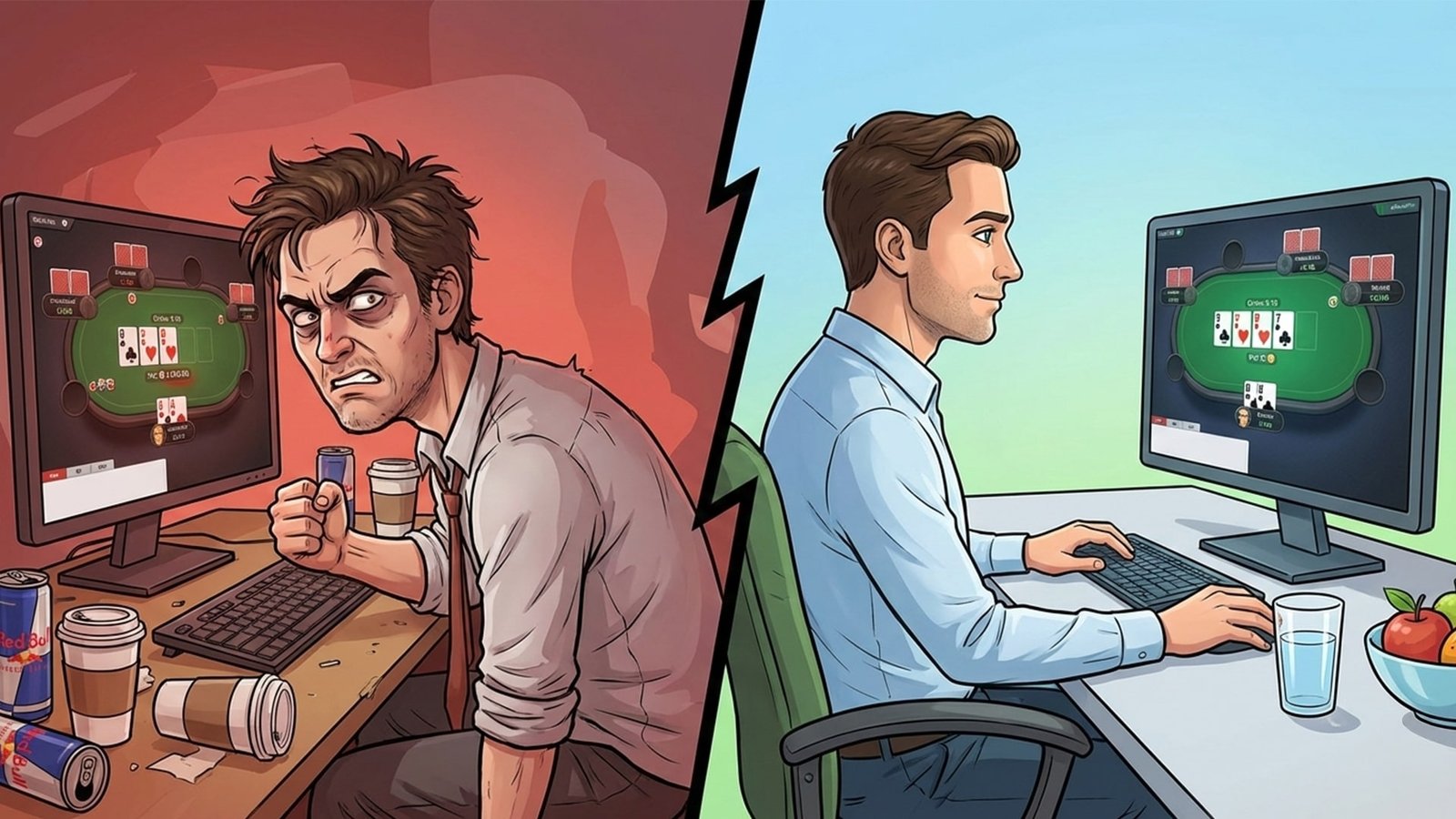
On the whole, the healthier and fitter you are, the less you will tilt. Have you ever seen Patrik Antonius rant or tilt? Rarely.
How about Phil Hellmuth? I bet he likes a big juicy burger on the regular and never goes to the gym…
Prioritize mental and physical health, and your chances of drifting into the tilt-zone drop dramatically.

The Ultimate Mindset During Play
You've done the preparation, and as important as that is, how you handle things in the heat of the moment is what it ultimately comes down to.
Even though you would like to have the reliability of a computer when it comes to making decisions—or 'computing' the processes happening in your mind—you just don't. Our minds can be fragile. We perform at our best in a calm and meditative state (remember to meditate regularly!), and we tend to lose all reason when getting upset (tilted!).
Stay humble, calm, and aware
It is important to accept and acknowledge this shortcoming, and to approach the game with humility. You may have a big ego, and hey, your game may be great enough to fuel or allow it. But acknowledge the instability of your own mind, then start monitoring it (meditation can help tremendously with that part too!).
Being aware of your own mental state is key here, and it can give you the signs of when it's best to quit the session. You have to be able to acknowledge when you're getting tilted, and sometimes it's best to even speak it out loud.
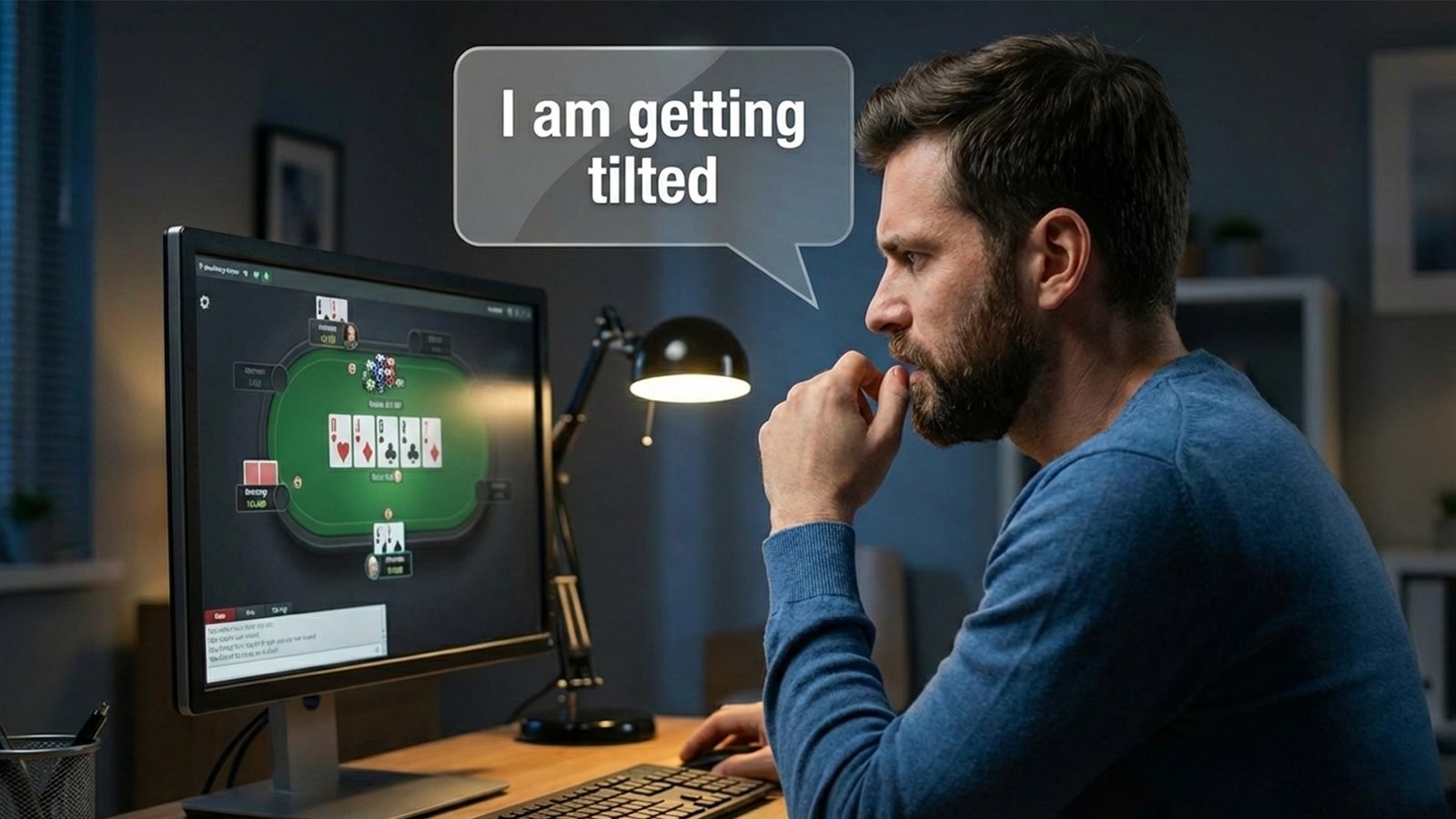
The worst tilt is the kind you aren't aware of or won't acknowledge; that's when the biggest blunders tend to happen. Tilt can be lurking right behind closed doors, pressing against your awareness. Then, when that big river shove comes, it can break through during those crucial 'big pot moments', causing you to make a multi-BB blunder you'll feel really bad about later.
It's best to catch it beforehand. Admit that the tilt has arrived—even speak it out loud. This awareness allows you to either quit the session before that blunder happens, or avoid making it because you're fully conscious of what's going on in your mind. You can stay more in control, and your intelligent 'poker brain' processes are compromised less.
Fighting results-orientedness
Ideally, of course, it's best if our mental state isn't affected by our short-term session swings at all. But it is, it just is, and that's because we are playing a game, and we want to win. We are playing to win money, there is no doubt about it, so when it doesn't work out, it affects us. Still, we have to try to not put so much weight on it. That can be done by playing vastly over-rolled. If you have a bankroll of $100K and you are playing 200NL, losing those 6 buy-ins in a session doesn't make you quite as tilted as when your roll was $20K, so that's one thing. Of course, then we're dealing with the dilemma of maximizing your hourly rate, but it's something to keep in mind, and it remains an effective measure nonetheless.
Then you can try reframing: maybe you just don't hop into a playing session to win money. Maybe you're just practicing, and the real joy is after the session when you are analyzing your major decisions. You get the joy of learning from your mistakes ("Yes! I am improving!"), and the joy of confirmation, the moments you were spot-on, the "Yes, I am sharp" moments.
Do it for that, and the playing sessions just become a precursor to the 'real' good moments, the true improvement, the dopamine hits. You can even get your early "micro-doses" while playing, just in anticipation of the study session to come. Easier said than done, but rewiring your dopamine reward system to favor study over results is one of the most masterful adjustments you could ever make, and an absolute pro move.

What if tilt does strike?
Now let's say all of this didn't help; the lifestyle habits, the preparations, you are humble and aware and you tried to stay calm, but it just didn't work. Variance got the best of you. What should you do?
Of course, the easy (and lame) answer is quitting. We all know this. You should quit when you tilt. But we also know how hard that can be at that moment. Now why is that? Why is it so hard to quit?
Well, at first glance, you may think it has something to do with admitting defeat; you're dealing with your ego being threatened. That is true, and let's try to get an even clearer picture of this.
Internally, your brain is flooding with adrenaline and cortisol, and you find yourself in some form of fight-or-flight response. You are in 'fight mode.' You know how hard it is to go from 'fight mode' to 'flight mode' once you're already in it?
We can right now imagine how easy that should be, being in a calm state (me writing this and you reading this); "It's simply a +EV decision to quit right now…" But hey, at the moment? You can't think like that, and we both know it. All reason is gone, and your brain seems to be one big mush of muddy waters.
One awesome way would be to hook us up to a heart rate monitor, then hook that up to the computer. Make the system such that, when your heart rate has been consistently high past a certain rate for long enough (longer than 1 or 2 hands, let's say), all your tables go automatically on sit-out. That is honestly something awesome that doesn't really exist yet.
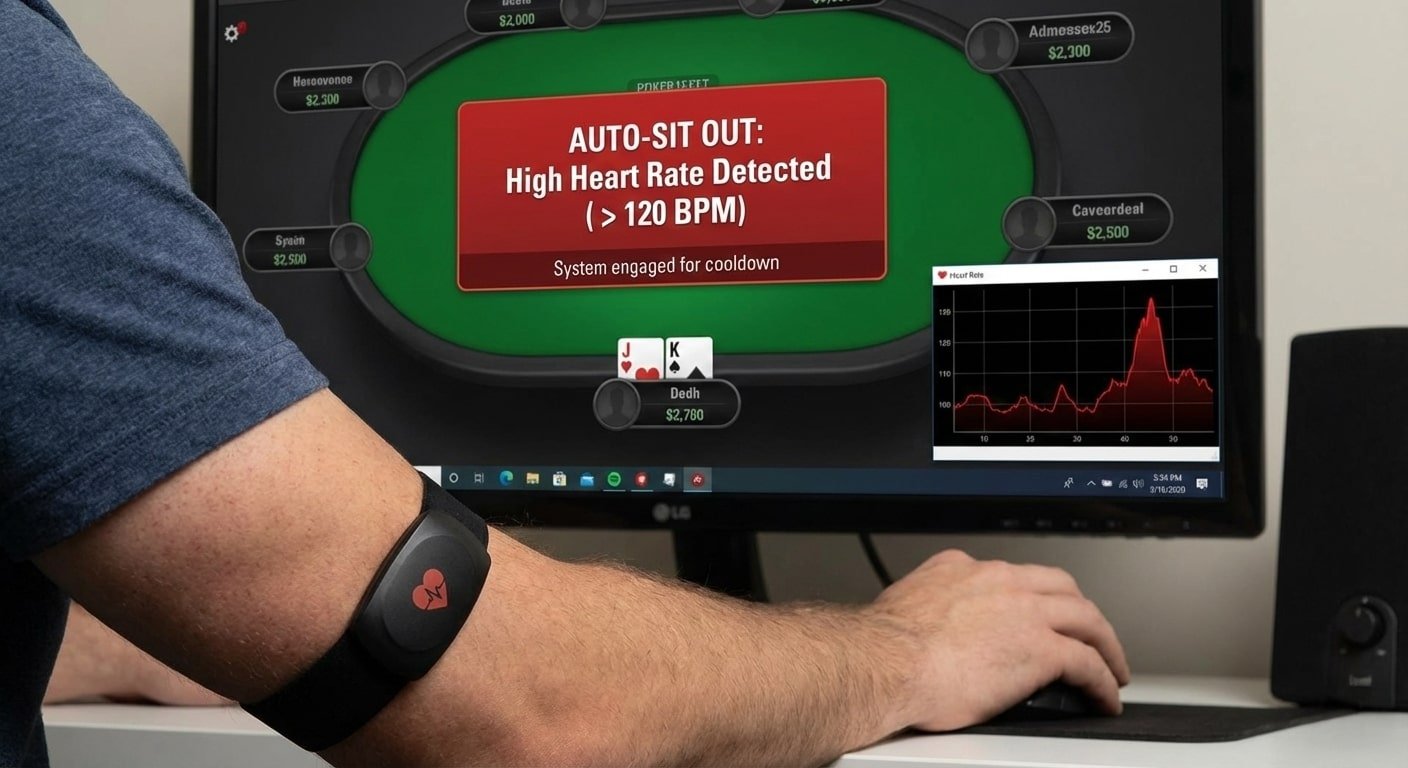
This article isn't about that, though, and right now we have to come up with something other than such external control. It has to come from within, we have to be able to access our reason again, and the only way to do that is to try to get calmer.
One perfect method for this is called physiological sighing. This is a method that's grounded in science, and is maybe the best method to calm yourself down in an instant.
Here's how you do it:
It's simple: Take a full, deep inhale through your nose. Then, at the very top, when you feel you can't breathe in anymore, take another sharp, "topping-off" inhale. You'll feel your chest expand that little bit extra. Finally, let it all go with a long, slow, controlled exhale through your mouth. That's it. Do this just two or three times. This double-inhale is the key, as it forces the small air sacs in your lungs (alveoli) to reinflate, and the long exhale then dumps the maximum amount of CO2, signaling your brain to stand down.
Here's Dr. Huberman explaining it on the Tim Ferriss podcast:
If you manage to find enough reason to start physiological sighing, you have a real chance of calming yourself down—hopefully enough to make a more informed decision about whether it's higher EV to quit or to continue playing. If you're past the point where you're thinking "to hell with that," you're probably just going to have a bad day and you've surrendered to your tilt. Better luck next time!
Note:
I am not saying to surrender to it, though. It's better to force yourself to do the sighing until you're calmer. I'm just saying there may be points where you're too far into your internal mayhem that you just can't bring yourself to it. Don't let it get past that point! Feel free to start the breathing exercise much sooner than that! Good luck with it.
The Mindset Outside of Play
Now, how to deal with the after-tilt mood dip and fogginess? And how to stay mentally stable during extreme variance? And how to ensure tilt doesn't start carrying over from session to session?
You gotta know that, mathematically, downswings aren't real. It's us humans that make them a thing. For us, they are a thing. We are obviously affected by them; we can see them in our graph, also! The goal is to make them 'not real' for us, just as they aren't real mathematically. We have to go with the math, follow reason, and try to ignore our emotions when we can—or otherwise neutralize them so they won't have power over us anymore.
Poker is this ever-present internal battle between our reasoning mind and our emotional mind. It's about taming ourselves, a continuous practice of self-control. Great for life too, but crucial for managing tilt and mitigating downswings.

With our reasoning mind, we understand we are playing for the long term. We understand the mathematical certainty of 'downswings', and we confidently continue forward, counting on our past long-term results and our winrates.
Still, we all have our breaking point where we feel the downswing is real, and it has gotten a hold on us. The emotional mind can take over at such moments, so it becomes key that we fight this internal battle to ensure our reasoning mind wins in the end.
One of the best ways to win this battle is to study, study, study. It may not be the most glamorous part of poker, or feed our competitive spirit and lust for adrenaline, but it ensures that our reasoning mind starts dominating again.
Feed that reasoning mind by analyzing all hands of your (losing) sessions. Learn, gain confidence, and become rational again. Meanwhile, do not play until you stop believing you 'are in a downswing', or until you've genuinely forgotten about it. Do not play the downswing away; study it away. This way, you avoid additional tilt, and you become a much better player in the process. Do it the right way like this, and you may never experience a downswing ever again—at least psychologically.
A Quick Note About Caffeine
Unfortunately for avid coffee drinkers, caffeine promotes tilt rather than preventing it. It revs up your nervous system, raises your heart rate, and floods your body with adrenaline. Physiologically, this puts you in a state that feels very similar to stress or mild anxiety. So, when a bad beat strikes, your system is already half-primed for 'fight or flight.' That tiny spark can easily become a raging inferno, pushing you into full-blown tilt. So definitely don't overcaffeinate.
What you can do, however (if you really can't quit coffee), is pair it with L-Theanine. This amazing amino acid, naturally found in green tea, acts like a smooth operator. It counteracts the jittery, anxious side effects of caffeine without killing the focus. So instead of anxious energy, you get a calm, clear focus. This is a game-changer for maintaining composure during long sessions and keeping those tilt-triggers at bay.
Try to enjoy herbal teas; I've mentioned them before. Herbs like chamomile, passionflower, and lemon balm are fantastic for calming the nervous system. Learn to drink them instead of coffee, especially later in the day, and your chance of tilt will drop dramatically.

Another great aid to support your nervous system is magnesium. Most players are deficient because stress depletes it. Supplementing with a high-quality form (like magnesium bisglycinate) helps relax your muscles and mind, improves sleep quality, and generally keeps you from feeling irritable and on edge—all crucial for preventing that slow burn into tilt.
Finally, another great tip I can give you in terms of supplements is Ashwagandha. You can order capsules online or in powder form, whatever you like. But it's an adaptogenic herb that helps your body adapt to stress by significantly reducing cortisol levels. Some people even 'complain' that it levels them off 'too much,' making them feel totally emotionally indifferent about anything. But hey, you can't be emotionally indifferent enough when it comes to poker, right?
The Ultimate Safety Net for Downswings: The Rest of Your Life
With all the lifestyle habits, tricks, and tools in place, it's time to start zooming out. Just as downswings disappear if we zoom out far enough on our graph, they can also disappear if we zoom out far enough on our life. It is about context.
We can't zoom out on a graph if we don't play enough hands—if the sample size is too small, there is no long-term context. The same goes for our life; we have to create a life for ourselves that is expansive enough and has enough context around poker so that negative variance doesn't make our overall life negative. We need sufficient emotional compensation during downswings, so they don't affect us too deeply on a personal level.

What else in life can lift us up enough to counteract that negative variance? If you can't think of anything, it's time to first work on creating a better life before working on your game. It can be anything you're passionate about otherwise; it can be self-care, it can be human connection. All valuable things outside of poker that are part of your life will enable you to zoom out on your life to diminish those so-called 'downswings.'
Make your life rich enough outside of poker so you can always zoom out far enough to diminish downswings, just like you can do on graphs. Then, you can have all the tools and tricks discussed in this article in place, to not let tilt affect your win-rate too much. This holistic approach enables you to be a relatively tilt- and downswing-free poker player who loves life, and loves poker, most of the time.